Trino — Federated SQL Query Engine
Trino runs distributed SQL over the Iceberg catalog (Polaris) and other sources. It is the query engine behind Superset and the Control Panel.
- Chart:
trino1.42.2(Trino 480) fromtrinodb.github.io/charts - Ingress:
trino.aetherlake.local→core-data-stack-trino:8080— the browser route is additionally gated by Keycloak SSO through oauth2-proxy (nginx external auth). Every request is then authenticated by Trino itself (PASSWORD,JWT), so neither the gate nor the cluster network alone grants anything. Behind the gate the web UI runs with the fixed service user (web-ui.authentication.type=fixed,web-ui.user=aetherlake-ui), which is intentionally read-only. See Keycloak — SSO gate. - In-cluster:
https://core-data-stack-trino:8443— TLS all the way; clients verify the AetherLake CA (see below). There is no unauthenticated path to the query API.
Architecture
Authentication — every query runs as a real user
Trino authenticates every request (http-server.authentication.type=PASSWORD,JWT); the old trust-the-X-Trino-User-header mode is gone.
JWT — interactive users. The Control Panel forwards the logged-in user's Keycloak access token (Authorization: Bearer …); Trino validates it against the aetherlake realm and maps the principal from preferred_username. So a query submitted by alice runs in Trino as alice.
- The realm RSA public key is mounted from the
trino-jwt-keyConfigMap thatinstall.shfetches through the Keycloak admin API. Keycloak's JWKS endpoint ishttp://only while Trino fetches JWKS overhttps://only — hence the mounted PEM. Re-runinstall.shafter rotating realm keys. http-server.authentication.jwt.required-issuer=http://keycloak.aetherlake.local/realms/aetherlake
PASSWORD (file authenticator) — service & dev users. password.db is rendered by install.sh (PBKDF2 hashes, never committed):
| User | Used by | Secret key |
|---|---|---|
control-panel-svc | Control Panel server-side admin queries (catalog page) | trino-panel-svc-password |
superset | Superset's Trino datasource | trino-superset-password |
mcp | MCP server (TRINO_BASIC_AUTH=mcp:<password>) | trino-mcp-password |
admin, user | Control Panel dev-credentials login (dev only) | trino-dev-admin-password, trino-dev-user-password |
TLS — everything over HTTPS
Authentication is only meaningful because it is cryptographically checked, which requires TLS — Trino serves HTTPS on 8443:
aetherlake-tls.yamldefines a cert-managerCertificate(core-data-stack-trino, in-cluster DNS names,trino.aetherlake.local, pluslocalhost/127.0.0.1for port-forward use), signed by the AetherLake CA. cert-manager renders a PKCS12 keystore (keystore.p12) into thetrino-tlssecret; Trino opens it with thetrino-keystore-passwordsecret key (injected byinstall.sh).- The nginx ingress forwards to the HTTPS port (
backend-protocol: HTTPS), so the browser path is TLS end to end. - CA distribution for verification:
aetherlake-caConfigMap (namespaceaetherlake) — mounted by the demo-data seed job (SSL_CERT_FILE) and readable by in-cluster clients.control-panel/.ca/aetherlake-ca.crt— exported byinstall.shfor local development; the panel's Trino client pins it automatically.- Any other client: export the root CA and trust it (
NODE_EXTRA_CA_CERTS,REQUESTS_CA_BUNDLE,curl --cacert, …).
- The plain-HTTP port (8080) remains for the chart's liveness probe and internal discovery only. With authentication enabled, Trino rejects client requests over plain HTTP (
allow-insecure-over-httpstays off), so no identity can be asserted without TLS.
Authorization — per-role access control
File-based system access control (trino.accessControl, rules reload without restart) + a file group provider map the Keycloak realm roles to Trino permissions. Group membership lives in group.db (rendered by install.sh — add new Keycloak usernames to a group line there and re-run install.sh).
| Group | Members | Catalogs | Notes |
|---|---|---|---|
data-admin | admin, control-panel-svc | all, incl. system | view/kill any query; schema ownership everywhere |
data-engineer | elif (demo), plus usernames assigned in install.sh | all except system | read-write; schema ownership on iceberg enables CREATE/DROP |
data-scientist | deniz (demo), user, superset, mcp, aetherlake-ui | read-only, no system | SELECT only |
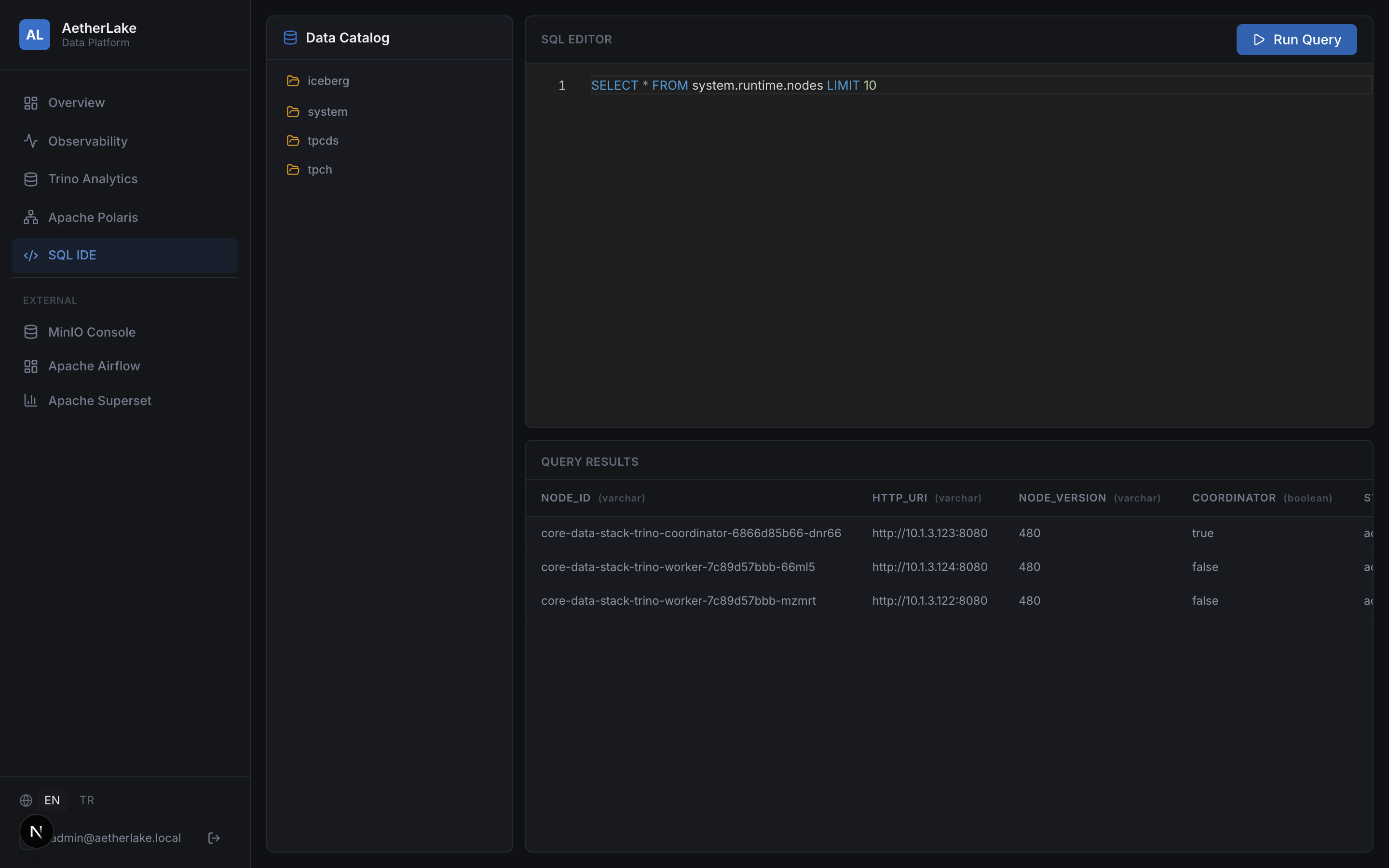
Visibility follows permissions automatically: SHOW CATALOGS / SHOW SCHEMAS / SHOW TABLES only list what the current user may touch, so the SQL IDE's schema explorer shows each user exactly their own slice of the lakehouse.
Keycloak role → Trino group
The realm roles (data-admin, data-engineer, data-scientist) decide the Control Panel UI; the same names as Trino groups decide what Trino itself allows. Keep a user's Keycloak role and group membership in sync.
The iceberg catalog
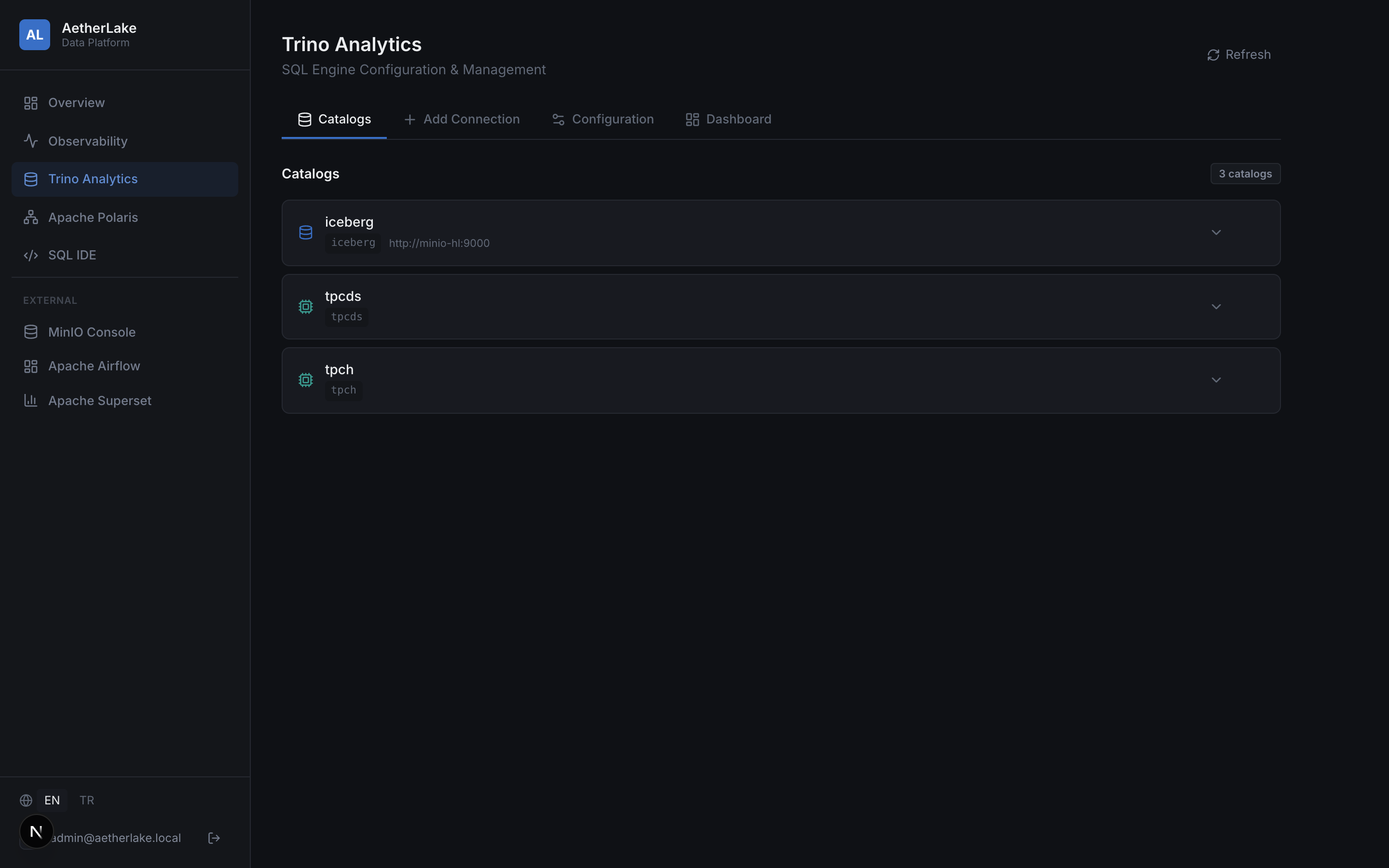
Trino is pre-configured with an iceberg catalog backed by the Polaris REST catalog. Key properties (trino.additionalCatalogs.iceberg):
connector.name=iceberg
iceberg.catalog.type=rest
iceberg.rest-catalog.uri=http://core-data-stack-polaris:8181/api/catalog
iceberg.rest-catalog.warehouse=lakehouse_catalog
iceberg.rest-catalog.security=OAUTH2
iceberg.rest-catalog.oauth2.credential=${ENV:POLARIS_CREDENTIAL}
iceberg.rest-catalog.oauth2.scope=PRINCIPAL_ROLE:ALL
iceberg.rest-catalog.vended-credentials-enabled=true
fs.native-s3.enabled=true
s3.endpoint=http://minio-hl:9000
s3.region=us-east-1
s3.path-style-access=true
OAuth2 scope needs Trino ≥ 458
iceberg.rest-catalog.oauth2.scope=PRINCIPAL_ROLE:ALL is required by Polaris but only supported since Trino 458 — hence the chart bump to Trino 480.
The kafka catalog
Kafka topics are queryable as SQL tables, so data streamed by Flink SQL jobs (e.g. the datagen → events pipeline) can be inspected with ordinary Trino SQL — including from the Control Panel SQL IDE:
SELECT * FROM kafka.aetherlake.events LIMIT 10;
-- event_ts arrives as text (Flink's json format writes SQL timestamps):
SELECT parse_datetime(event_ts, 'yyyy-MM-dd HH:mm:ss.SSS') FROM kafka.aetherlake.events;- Catalog properties:
trino.additionalCatalogs.kafka(kafka.nodes=aetherlake-kafka-bootstrap:9092,FILEtable-description supplier reading/etc/trino/schemas). - Column schemas come from
trino.kafka.tableDescriptions(one JSON file per topic, mounted by the trino subchart). Add an entry there for every new topic; theeventsdescription mirrorspipelines/flink/examples/ datagen-to-kafka.sql.
Key settings (core-data-stack/values.yaml → trino)
| Setting | Default | Description |
|---|---|---|
trino.enabled | true | Toggle Trino |
trino.server.workers | 2 | Number of worker pods |
trino.server.config.authenticationType | PASSWORD,JWT | HTTP authentication types (see above) |
trino.additionalCatalogs.iceberg | (see above) | Iceberg/Polaris catalog |
trino.additionalCatalogs.kafka | (see above) | Kafka connector catalog |
trino.kafka.tableDescriptions | events.json | Per-topic JSON schemas for the kafka catalog |
trino.accessControl | file rules | Role-based catalog/schema/query rules (rules.json, 10s refresh) |
trino.auth.passwordAuth / trino.auth.groups | (install.sh) | password.db / group.db, injected at install time |
trino.configMounts[trino-jwt-key] | (install.sh ConfigMap) | Realm RSA public key for JWT verification |
trino.server.config.https | enabled: true, port 8443 | HTTPS listener; keystore from the trino-tls secret |
trino.secretMounts[trino-tls] | cert-manager secret | TLS certificate + PKCS12 keystore |
trino.additionalConfigProperties | process-forwarded | Node-wide config.properties lines; coordinator-only ones (web-ui, JWT, keystore key, shared secret) are rendered by install.sh |
trino.env[MINIO_ACCESS_KEY] | secret minio-root-user | S3 access key |
trino.env[MINIO_SECRET_KEY] | secret minio-root-password | S3 secret key |
trino.env[POLARIS_CREDENTIAL] | secret polaris-credential | Polaris OAuth2 id:secret |
Why process-forwarded is required
Trino runs behind the NGINX ingress, which injects X-Forwarded-* headers. By default Trino's HTTP server (airlift) rejects forwarded requests with HTTP 406 — Server configuration does not allow processing of the X-Forwarded-For header. That breaks both the Trino web UI and the Control Panel SQL IDE, which call /v1/statement through trino.aetherlake.local. Setting http-server.process-forwarded=true (applied to the coordinator and workers via additionalConfigProperties) allows those headers and resolves the 406.
Credential vending
With vended-credentials-enabled=true, Trino uses the short-lived, table-scoped S3 credentials that Polaris vends per query, instead of the static keys (which remain as a fallback for non-vended catalog operations). See Polaris.
Try it
# Trust material + tunnel to the HTTPS listener
kubectl get secret aetherlake-root-ca -n cert-manager \
  -o jsonpath='{.data.ca\.crt}' | base64 -d > /tmp/aetherlake-ca.crt
kubectl port-forward -n aetherlake svc/core-data-stack-trino 8443:8443 &

PASS=$(kubectl get secret aetherlake-credentials -n aetherlake \
  -o jsonpath='{.data.trino-mcp-password}' | base64 -d)

# Authenticated query (mcp service user, read-only):
curl -s --cacert /tmp/aetherlake-ca.crt -u "mcp:$PASS" \
  -X POST https://localhost:8443/v1/statement -d 'SHOW CATALOGS'

# Unauthenticated requests are rejected (expect a 401):
curl -s --cacert /tmp/aetherlake-ca.crt -o /dev/null -w '%{http_code}\n' \
  -X POST https://localhost:8443/v1/statement -d 'SHOW CATALOGS'
For multi-statement exploration (CREATE TABLE, INSERT, SELECT) use the Control Panel SQL IDE — it forwards your own Keycloak identity, so what you see there is exactly your permission slice.