Apache Polaris — Iceberg REST Catalog
Polaris is the Iceberg REST catalog: it tracks table metadata and vends short-lived, scoped S3 credentials to query engines. It is a local subchart (helm-charts/core-data-stack/charts/polaris) running apache/polaris:latest.
- Ingress:
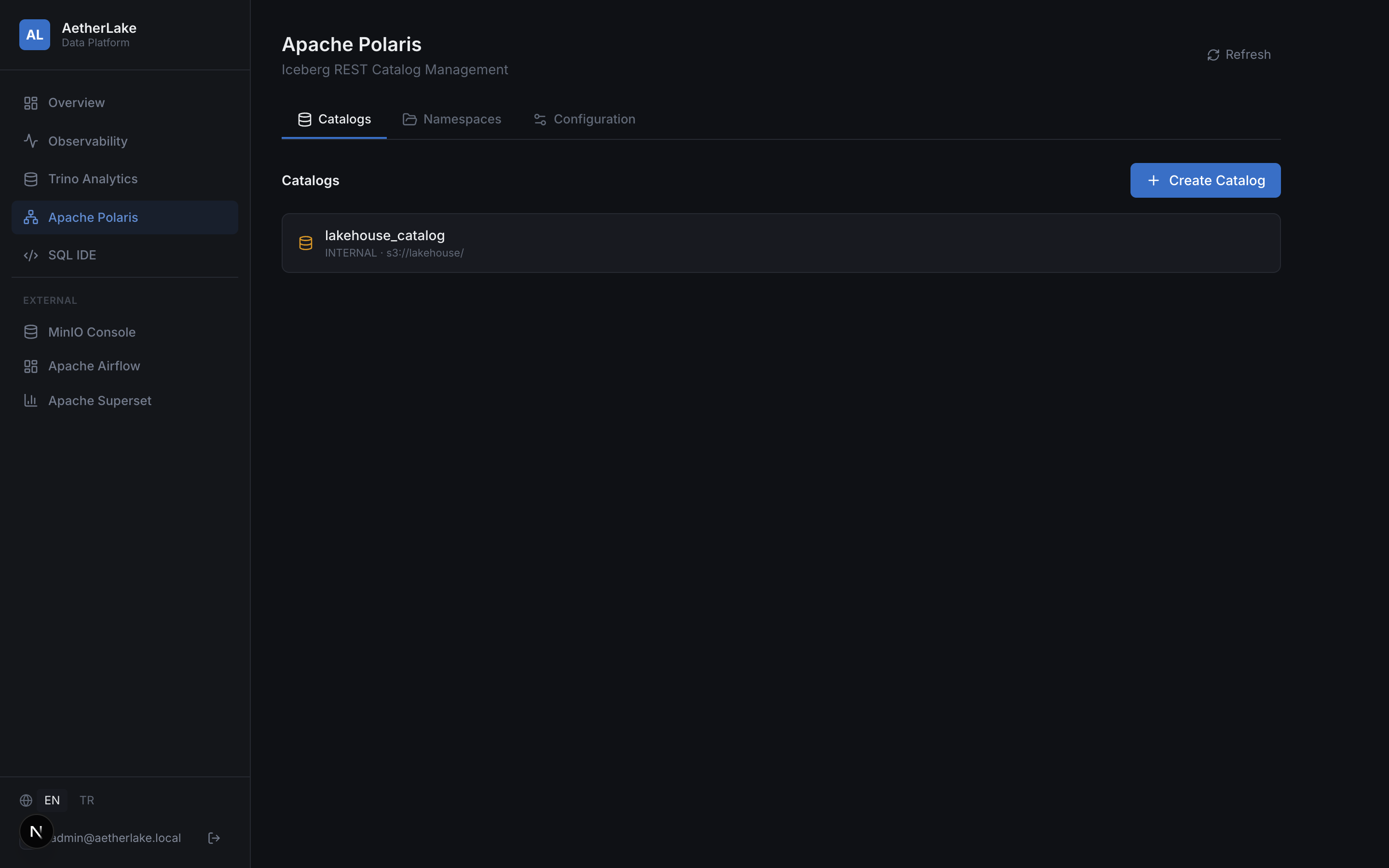
polaris.aetherlake.local→core-data-stack-polaris:8181 - Catalog:
lakehouse_catalog(base locations3://lakehouse/) - Realm:
POLARIS(Polaris-internal, distinct from the Keycloak realm)
Architecture
Persistence (PostgreSQL metastore)
Polaris defaults to an in-memory metastore that loses all catalogs on restart. AetherLake uses a relational-jdbc metastore on the shared aetherlake-postgres (database polaris). Two init-containers make this idempotent across restarts:
init-db(postgres image): waits for postgres, creates thepolarisdatabase if missing, and flags whether thepolaris_schemaschema needs bootstrapping.bootstrap(admin-tool image): runspolaris-admin-tool bootstraponly when the schema is empty (re-running bootstrap on an initialized DB errors).
Persistence settings (polaris/values.yaml → persistence)
| Setting | Default | Description |
|---|---|---|
persistence.postgres.host | aetherlake-postgres | Shared postgres service |
persistence.postgres.port | 5432 | Port |
persistence.postgres.database | polaris | Metastore DB |
persistence.postgres.username | postgres | DB user |
persistence.postgres.passwordSecret | open-lake-credentials | Secret name |
persistence.postgres.passwordSecretKey | postgres-password | Secret key |
adminImage.repository | apache/polaris-admin-tool | Bootstrap tool image |
Credential vending (subscoping)
When a query creates/loads a table, Polaris calls MinIO STS AssumeRole to mint short-lived, table-prefix-scoped S3 credentials and vends them to Trino. This avoids handing long-lived root keys to query engines.
What makes vending work (all configured in the chart)
| Requirement | Where | Why |
|---|---|---|
Non-root MinIO user polaris + polaris-rw policy | minio-init Job | Root cannot AssumeRole |
AWS_ACCESS_KEY_ID/SECRET = minio-polaris user | Polaris deployment env | STS auth identity |
AWS_ENDPOINT_URL_STS=http://minio-hl:9000 | Polaris deployment env | Else AssumeRole hits real AWS (STS 403) |
Catalog storageConfigInfo top-level endpoint / stsEndpoint / pathStyleAccess | polaris-init Job | Nested properties.s3.* keys are ignored; without path-style the S3 client tries bucket.minio-hl (UnknownHost) |
roleArn + allowedLocations | polaris-init Job | Required by the AWS SDK; MinIO scopes by the user's policy |
Trino vended-credentials-enabled=true | Trino catalog | Use the vended creds |
Disabling subscoping
For a single-tenant dev setup you can skip vending: drop roleArn / vended-credentials-enabled, point Polaris back at the MinIO root creds, and add the Polaris SKIP_CREDENTIAL_SUBSCOPING_INDIRECTION feature flag. Subscoping is ON by default here for least-privilege access.
Catalog RBAC (required for table writes)
When a catalog is created, Polaris auto-creates a catalog_admin catalog-role and assigns it to the service_admin principal — but only with CATALOG_MANAGE_ACCESS and CATALOG_MANAGE_METADATA. Those cover metadata, not data. Creating a table through Trino uses write delegation (vended credentials), which needs CATALOG_MANAGE_CONTENT. Without it every CREATE TABLE fails:
Failed to create transaction
  Principal 'root' … is not authorized for op
  CREATE_TABLE_STAGED_WITH_WRITE_DELEGATION
The polaris-init Job therefore grants CATALOG_MANAGE_CONTENT to catalog_admin after creating the catalog (idempotent, also applied on upgrades):
PUT /api/management/v1/catalogs/{catalog}/catalog-roles/catalog_admin/grants
{ "grant": { "type": "catalog", "privilege": "CATALOG_MANAGE_CONTENT" } }
Drop-with-purge (required for DROP TABLE)
Trino's DROP TABLE against an Iceberg REST catalog requests a purge (delete the table's data and metadata files), but Polaris refuses purges by default:
Failed to drop table 'X'
  (Polaris) Unable to purge entity: X. To enable this feature, set the Polaris
  configuration DROP_WITH_PURGE_ENABLED or the catalog configuration
  polaris.config.drop-with-purge.enabled
The polaris-init Job enables it per catalog by setting polaris.config.drop-with-purge.enabled=true in the catalog properties at creation. For catalogs created before this was added, the Job also patches the property in idempotently (it fetches the catalog's entityVersion and PUTs the updated properties, skipping the write if the flag is already set):
PUT /api/management/v1/catalogs/{catalog}
{ "currentEntityVersion": <n>,
  "properties": { "default-base-location": "s3://lakehouse/",
                  "polaris.config.drop-with-purge.enabled": "true" } }
Verify end-to-end through Trino:
CREATE TABLE iceberg.demo.tmp (id int);
DROP TABLE iceberg.demo.tmp;  -- succeeds once drop-with-purge is enabled
Bootstrap / root credentials
| Env | Source | Description |
|---|---|---|
POLARIS_CLIENT_ID | secret polaris-client-id | Root principal id (default open-lake-admin) |
POLARIS_CLIENT_SECRET | secret polaris-client-secret | Root principal secret (randomized) |
POLARIS_BOOTSTRAP_CREDENTIALS | POLARIS,$(id),$(secret) | Realm bootstrap |
SMALLRYE_JWT_VERIFY_ISSUER | …/realms/aetherlake | Keycloak token issuer for JWT auth |
Operations
# Get an OAuth2 token + list catalogs (run inside the cluster)
CID=$(kubectl get secret open-lake-credentials -n aetherlake -o jsonpath='{.data.polaris-client-id}' | base64 -d)
CS=$(kubectl get secret open-lake-credentials -n aetherlake -o jsonpath='{.data.polaris-client-secret}' | base64 -d)
# POST grant_type=client_credentials&client_id=$CID&client_secret=$CS&scope=PRINCIPAL_ROLE:ALL
#   → /api/catalog/v1/oauth/tokens, then GET /api/management/v1/catalogs
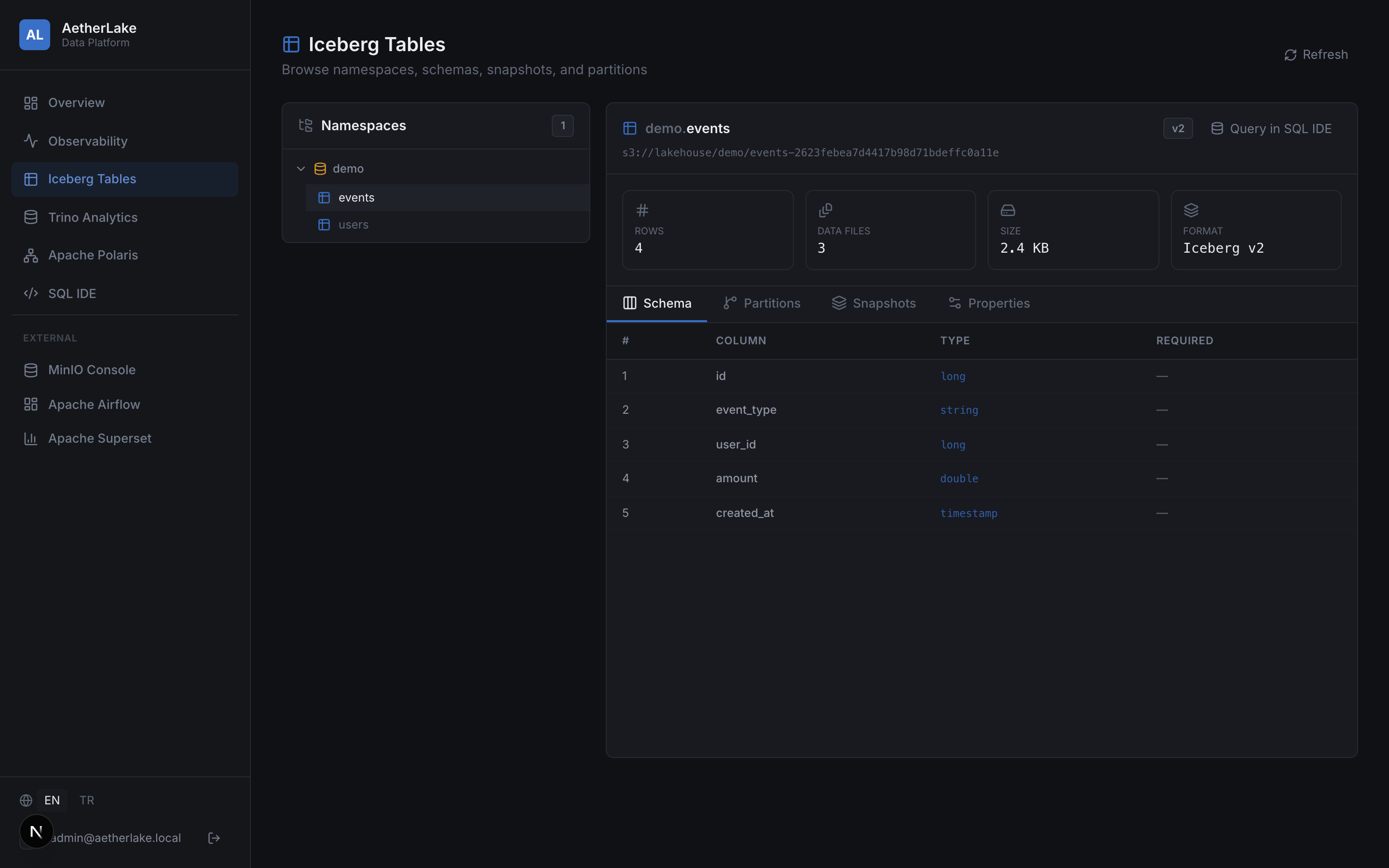
Tables stored in Polaris namespaces can be visually browsed, inspected, and previewed with live data from the Iceberg Tables Explorer: